Overview
What Are Soldier Piles?
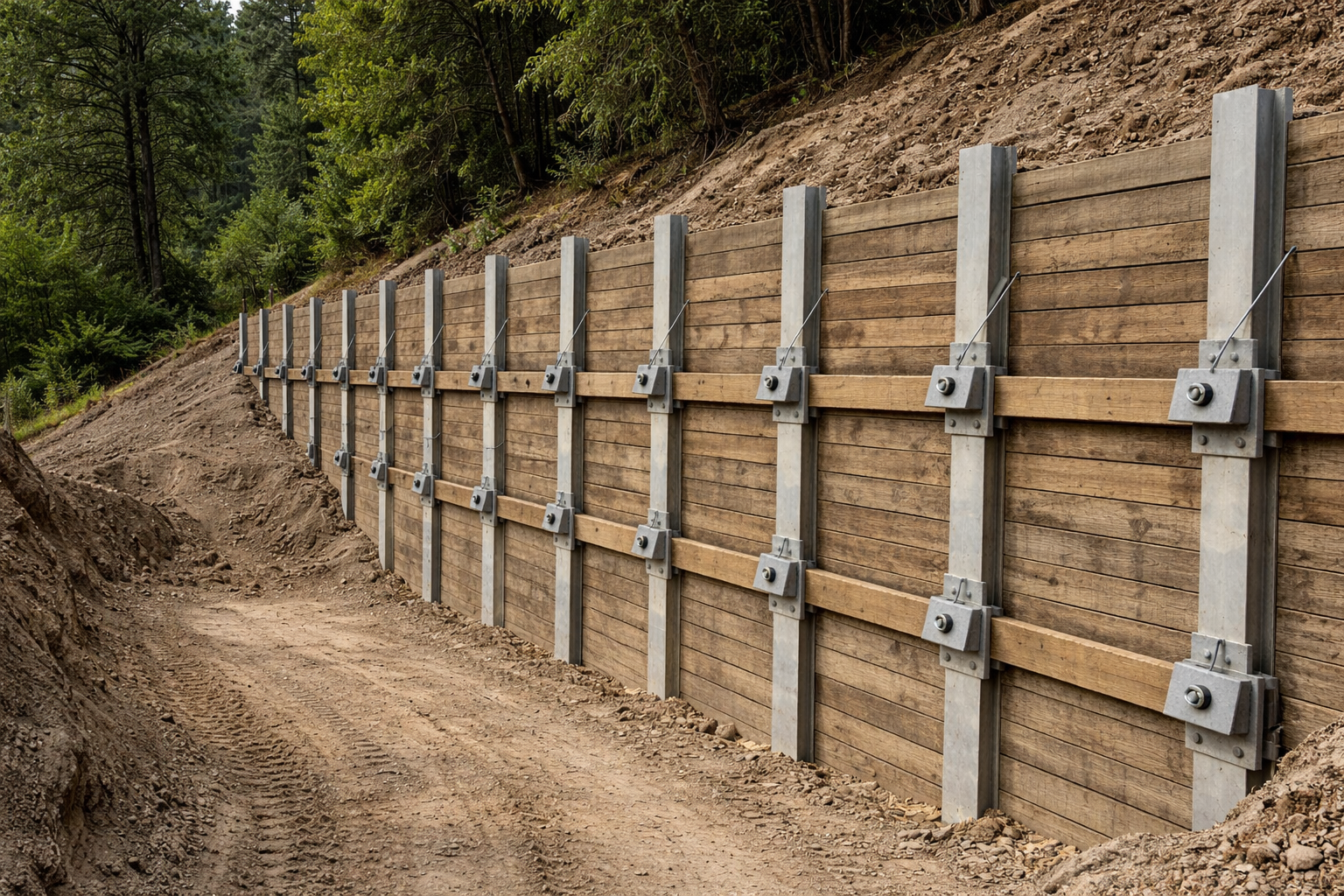
Soldier pile walls are one of the most widely used earth retention systems in commercial construction. Steel H-piles or wide-flange beams are drilled into the ground at regular spacing (typically 6’–10′ on center), then timber or concrete lagging is placed between the piles as the excavation progresses to retain the soil behind the wall.
Rocky Mountain Micropiles drills and sets soldier piles for excavation support systems across the Wasatch Front and Intermountain West. Our drilling capabilities handle the full range of ground conditions — from soft clays and sands to cobble-rich alluvial deposits and weathered bedrock.
Soldier pile walls can be designed as temporary excavation support or permanent retention, and are frequently combined with tieback anchors for deeper excavations where cantilever capacity alone is insufficient.
Technical Data
Soldier Pile Specifications
Key technical parameters for our soldier pile systems. Actual design values are project-specific and determined by structural and geotechnical analysis.
Holes are drilled to accept the steel beam plus lean concrete or grout backfill around the embedded portion below subgrade.
Spacing is optimized based on soil lateral pressure, wall height, and whether tiebacks are used. Closer spacing increases wall stiffness.
Total pile length includes both the exposed cantilever portion and the embedded toe below subgrade providing passive resistance.
Wide-flange beams (HP sections or W shapes) selected based on required section modulus. Grade 50 steel standard.
Rough-sawn timber lagging (3″–4″ thick) placed between pile flanges as excavation progresses. Concrete lagging available for permanent walls.
Designed as temporary excavation support or permanent retention with concrete facing and corrosion protection for long-term service.
Applications
Where Soldier Piles Are Used
Soldier pile walls are the go-to shoring solution for commercial excavations where the retained soil is above the water table and a proven, cost-effective retention system is needed.
Discuss Your ProjectCommercial Building Excavations
Basement, parking garage, and below-grade excavation support for commercial, retail, and multi-family construction projects.
Adjacent Structure Protection
Retaining soil next to existing buildings, utilities, and roadways during excavation to prevent settlement and lateral movement.
Utility Corridor Retention
Deep trench and utility corridor support where open-cut slopes aren’t possible due to right-of-way constraints.
Tieback-Supported Walls
For excavations deeper than cantilever limits, soldier piles are combined with tieback anchors for additional lateral support.
Permanent Retaining Walls
With concrete lagging and corrosion protection, soldier pile walls serve as permanent earth retention for grade separations and property line walls.
Bridge & Highway Infrastructure
Excavation support for bridge abutments, highway widening, and infrastructure projects adjacent to live traffic.
How It Works
Soldier Pile Installation Process
Piles are installed before excavation begins, then lagging is placed as the contractor digs.
Layout & Locate
Survey pile locations per shoring plan. Locate and clear underground utilities.
Drill Holes
Drill oversized holes to full design depth using auger or casing methods.
Set Beams & Backfill
Steel beams are crane-set, plumbed, and backfilled with lean concrete or structural grout.
Excavate & Lag
As the GC excavates, timber or concrete lagging is placed between pile flanges.
Tiebacks (If Req’d)
For deeper walls, tieback anchors are drilled and locked off at design load for additional lateral support.
Comparison
Soldier Piles vs. Alternative Shoring Systems
A proven, cost-effective shoring solution with clear advantages in the right ground conditions.
vs. Sheet Piling
No vibration from driving. Soldier piles are drilled — not driven — making them ideal for urban sites near sensitive structures.
vs. Secant/Tangent Piles
Lower cost and faster installation when groundwater cutoff isn’t required. The economical choice for dry excavations.
vs. Soil Nail Walls
Piles are installed before excavation, providing engineered support from the start. Best when soil has low stand-up time.
vs. Internal Bracing
Combined with tiebacks, soldier pile walls keep the excavation open and unobstructed for foundation work and material staging.